



Learn Spanish in Barcelona: Teaching
Let’s get you talking Spanish in Barcelona!
Teaching Methods
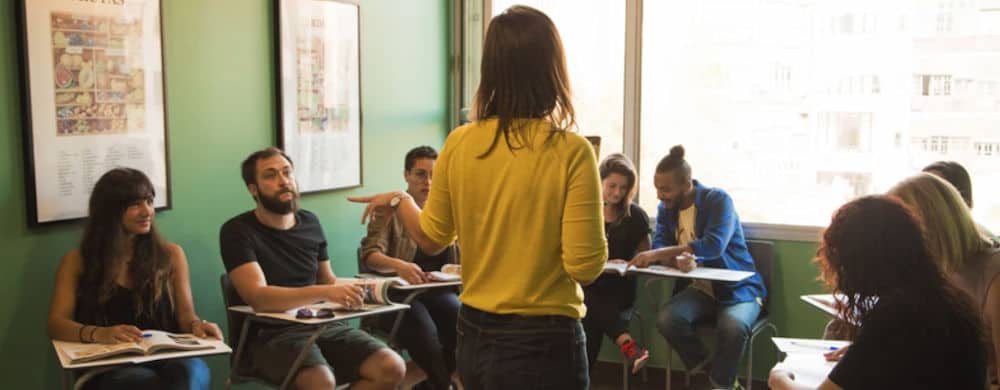
The main focus is to improve communicative skills, the classroom activities in Barcelona are therefore aimed at developing the students’ abilities to speak and understand spoken Spanish. Classes are ONLY conducted in Spanish and students are given many opportunities to practise the style of language they would use outside the classroom. The college want you to be able to actively “use” the Spanish language not just “know” it academically!
The curriculum is structured on a range of theoretical language levels, from beginner to advanced ability. There are of course classes in grammar, oral and written exercises, practice with video and audio material and conversation on subjects of general and cultural interest.
The methodology is the result of years of experience in the teaching of Spanish. Special importance is given to the communicative aspect of the language and its use in everyday life. Whilst the classroom atmosphere is relaxed and informal, students have to be prepared to work hard and participate fully.
The teaching and the course programme are carefully supervised by the Director of Studies, who is also responsible for ensuring that students are placed in the appropriate levels and that their progress is satisfactory.
Our teachers, native Spanish speakers use this framework as well as the communicative method, which encourages students to communicate in Spanish during the lessons. In this way, the student will be able to develop the four essential languages skills: reading, listening, speaking and writing. Through this intensive Spanish course in Barcelona, you will gain all the skills you need to achieve your language learning goals!
Spanish Language Levels
What follows is a chart which represents Spanish language level advancement from A1 (Beginner) to C2 (Master of Proficiency), as well as the number of weeks, suggested to progress to each subsequent level. Throughout the levels, Expanish maintains a flexible approach, as our Spanish teaching methods adapt the classroom dynamic to address the learning needs and strengths of each group. Advancement speed is determined by a group dynamic, allowing the students to advance together.
| C2 | Master of Proficiency Student is easily able to understand basically everything he/she hears or reads; understands how to restructure arguments and information from a variety of sources as well as present them in a coherent and correct manner. 10 weeks duration |
|
| C1 | An Advanced Student is able to recognize implicit meanings as well as complex texts. Student is able to effectively use the language for social, professional and academic purposes, and can also produce clean, well structured text on a variety of subjects. 10 weeks duration |
|
| B2 | An Upper Intermediate Student has no difficulty in understanding the main ideas of complex texts, and has the ability to produce detailed, clear texts on different topics, as well as defend their point of view. 8 weeks duration |
|
| B1 | An Intermediate Student is able to comprehend the main points of basic texts in straight forward language and is able to produce simple, coherent texts. Student is able to handle most situations that might arise during a trip. 8 weeks duration |
|
| A2 | An Elementary Student is able t0 communicate simple, daily tasks through direct information exchanges as well as information. Student is also able to describe his/her past, physical surroundings, and immediate needs in simple terms. 4 weeks duration |
|
| A1 | An Beginner Student is able to articulate and understand simple, frequently used everyday expressions as well as phrases designed to satisfy immediate needs. 4 weeks duration |
|
On the first day that you begin a Spanish course, there is both a written and an oral placement test.
Lessons will begin on the following morning (generally speaking Tuesday AM)
The main goal of most of our courses is to help our students develop their communicative skills. The best way to accomplish this is to conduct the classes entirely in Spanish and to provide students with plenty of opportunity for oral practice.
This does not mean that other areas are neglected; our students also work on reading and writing skills, grammar and vocabulary.
Language Course Content
Phase 1 – Beginners, Pre-Elementary, Elementary
Students develop basic skills in Spanish grammar, including gender and number nouns, adjective formation, adverbs, adverbial phrases, comparative and superlative, prepositions and the use of “ser” and “estar”.
Present, simple past and future tenses are presented at the appropriate level. Participants express needs and desires surrounding their daily routine and experience as a student in Barcelona. Students learn to identify and to describe people, places and objects in their environment and to express personal opinions in simple concrete language.
Other basic functions of language include: agreeing and disagreeing, asking for help, expressing lack of understanding and asking an interlocutor to repeat or to speak more slowly. Participants develop comprehension of simple written and spoken messages in a variety of media: signs, news highlights, announcements, personal letters, postcards, etc.
Instructors place language in its proper situational context which, at these levels, includes: the classroom, the workplace, the restaurant, the market/supermarket, the travel agency, the bus/subway, a celebration or sporting event, etc.
Phase 2 – Pre-Intermediate, Intermediate, Post-Intermediate
In the intermediate levels, students develop an increasingly accurate use of Spanish grammar. Building on work in previous levels, students learn more subtle and idiomatic uses of grammatical forms including contrasting uses of the perfect and imperfect tenses.
Instructors introduce complex verb forms such as the conditional and subjunctive moods for the first time. Students develop an understanding of more complex messages and learn to contribute comments and personal opinions to a conversation, turn taking and other conversational norms.
Participants begin to develop a passive understanding of colloquial phrases and slang. Students also learn to describe their personal experience in greater detail and to narrate events in the past with greater accuracy.
Situations and topics include: the family, making invitations, describing character or personality, relationships, planning a celebration, the movies, asking for advice from friends, family or others, appreciating art and music and looking for a job or apartment.
At this level, instructors begin to introduce more cultural topics and current events in the target language.
Phase 3 – Pre-Advanced, Advanced
The advanced levels provide students with an opportunity to hone their command of Spanish grammar, to develop fluency and to improve pronunciation.
Upon completion of Phase 3, students will have covered the core grammatical syllabus. Students develop greater idiomatic control of the language and begin to understand movies, read literary passages and write advanced texts.
Students develop ability with complex linguistic functions including: inferring opinions from a text or dialogue, arguing a point, recommending or giving advice and instructions and making predictions.
Themes at this level may include idiomatic expressions, relationships, the newspapers and media, contemporary music, theatre and cultural events, etc. Specific topics vary according to the needs and interests of the class.
Phase 4 – Post-Advanced, Proficiency
These are the most advanced grammar and conversation courses offered and the most individualised.
Instructors assess individual needs and design a programme to review complex grammatical forms that students have not fully mastered. As the names suggest, these courses are designed to perfect and polish linguistic ability.
Instructors use a range of media and materials to develop the courses around topics of interest to the participants. Students further develop colloquial conversational ability.
Students and instructors become co-creators of the course programme and work closely on individualised assignments.
Timetable
Group Course Timetable / Monday to Friday
Morning session: 09.30 to 13.30 hrs, with a twenty-minute break
Afternoon session: 14.30 to 18.30 hrs, with a twenty-minute break
Classes 4 lessons a day, giving 20 lessons a week
Class size 7 average, with a maximum of 10 students
High season:
During the busier months, some courses may be scheduled to take place in the afternoons-evenings.
Private Tuition Timetable
Offered Monday to Friday / Generally in the afternoons
Can be offered in the mornings on request (given sufficient notice)
Spanish Teachers
The Spanish teachers are all university graduates with extensive teaching experience. They have also been specifically trained to teach Spanish as a foreign language, which makes them highly effective when it comes to helping students maximise learning.
Teaching Materials
The education materials provided have been designed page by page by our very own professors, academic support team and students. We are proud to offer materials that incorporate learning opportunities based upon everyday situations that might occur in Spain. The lessons also include fun and useful Spanish slang, meaning that you will be able to experience a dynamic approach to learning how to write, read, speak and comprehend Spanish.
The materials are specifically designed for each language level: from A1 (Beginner) to C2 (Master of Proficiency). For each level our teachers have prepared activities and in-class lessons as well as assessments and vocabulary sheets for extra practice. These stimulating and challenging materials are included in the price of your programme, and perfect for taking with you to continue your studies as you travel or after returning home.
Spanish Students in Barcelona
Students come from all over the world to study Spanish at the language school in Barcelona. The majority of them are European, although there are always some Americans studying here. They also have a number of students from Asia (especially Japanese) and even some Brazilians, who come all the way to Barcelona to improve their language skills.
The average age of the Spanish students is 20 to 30 yrs of age, although the school cater for students as young as 17 yrs and adults of all ages. The majority of students are young professionals or students, who require Spanish to develop their careers, as well as an increasing number of people who are simply learning Spanish as a hobby.
| Student Profile: | |||
| Under 19 yrs | 06% | 19-24 yrs | 26% |
| 25-30 yrs | 28% | 31-34 yrs | 16% |
| 35-45 yrs | 13% | 45 yrs+ | 11% |
Spanish & Catalan
As most people now know, there are two official languages in Cataluña: Spanish (or Castilian) and Catalan. Catalan isn’t a dialect of Spanish; it is a separate language which in many respects is as close to French as it is to Spanish.
The Catalan government has spent a lot of money trying to increase the number of people who speak Catalan. Not surprisingly, some students have written to us asking whether Catalan could interfere with their Spanish studies. The answer is “no”. At our school in Barcelona, we teach Spanish (not Catalan) to our foreign students, and our host families will also speak Spanish (not Catalan) to them.
Students may overhear some conversations in Catalan, but they are equally likely to overhear conversations in English, French or Italian – Barcelona is a very cosmopolitan city!
According to a recent survey, over 67% of the people in Barcelona consider Spanish to be their first language. In small towns and villages Catalan is more widely spoken, but in Barcelona, because of a long history of immigration from other parts of Spain, the dominant language is very definitely Spanish. Most of the television channels currently available broadcast in Spanish, and all the leading newspapers – including those published in Barcelona – are also written in Spanish.
What’s more, everyone in Barcelona automatically uses Spanish to speak to foreign students as they don’t expect them to know any Catalan, so there is very little danger of students being asked to understand anything other than Spanish while they are here.
It is also worth noting that we always ask our students for feedback on every aspect of their course, and in all the years we have been teaching Spanish in Barcelona, not one student has ever complained about Catalan interfering with their studies. In other words, the perceived problem simply doesn’t exist.
Finally, it is also worth bearing in mind that all Catalans are totally bilingual and that they speak Spanish without any noticeable accent. So what Spanish students will hear in Barcelona is in fact much closer to “correct” Castilian Spanish than the Spanish they would hear in some other regions of Spain where Spanish is often spoken with a very strong regional accent.